About Rob Snyder

I currently work out of the Butte County Cooperative Extension in Oroville, CA as a Crop Protection Agent. I received my B.S. in biology from Delaware Valley College, PA. There I attained a majority of my entomological knowledge from Dr. Chris Tipping and Dr. Robert Berthold. After graduation, I was an apiary inspector for 2 years at the Department of Agriculture in Pennsylvania. In my third year there, I still inspected some colonies but I mainly focused on The Pennsylvania Native Bee Survey (PANBS) where I pinned, labeled, entered data and identified native bees to genus species. Leo Donavall assisted me in learning the basics on positive Identifications of the native bees. Around the same time I began working on coordinating kit construction and distribution for the APHIS National Honey Bee Survey. I was also fortunate to conduct many of these surveys with fellow co-worker Mike Andree and Nathan Rice of USDA/ARS throughout California. All of these experiences have led me to where I am today, working to assist beekeepers in maintaining genetic diverse colonies resistant to parasites while reducing the use of chemical treatments in colonies. The BIP Diagnostic Lab at the University of MD is in an integral part of this process by generating reports in which we can track change and report to beekeepers vital information in a timely manner which may influence their treatment decisions.

Bald Brood

Greater wax moth adult.

Greater wax moth adult.

This image shows a section of a frame with a wax moth tunneling below sealed brood.  This symptom is called Bald Brood.

This image shows a section of a frame with a wax moth tunneling below sealed brood. This symptom is called Bald Brood.

An interesting brood symptom you may come across in a weak hive in the spring is Bald Brood. Bald brood is caused by the Lesser wax moth (Achroia gresella) or the Greater wax moth (Galleria mellonella.) You can see in the image below the linear pattern of uncapping that occurs due to the wax moths tunneling behavior. These symptoms can sometimes be confused as hygienic behavior; I have included an image showing some hygienic behavior of uncapping. One visible difference between hygienic behavior vs. bald brood is that there is no linear pattern of uncapping sealed brood with hygienic behavior. Colonies with bald brood often have raised sidewalls that are slightly above the other sealed brood, this symptom is not usually present when bees are uncapping larva/pupa associated with varroa, a lethal gene or another brood disease. I have seen these symptoms a handful of times over the past several years but in most cases the colonies were weak ranging from 3-6 Frames of bees. The best defense against wax moth is a strong colony. If you investigate cells near the ends of the linear pattern you can probably find the wax moth larva, look for perforations in the sealed cells. For more information on wax moth please see my previous wax moth blog here “Wax Mothor “Jennie’s blog on Wax moth damage”.

This image is cropped from the image above to give you a close up of what bald brood looks like.  You can see the raised cell walls around the uncapped pupa.  Also, note the darker brown convex sealed cells in between the open cells (convex but not normal looking.)  This was the path of the wax moth larva.  There is a perforation in the cell to the right of the last uncapped cell.  I found the wax moth in that perforated cell.  There is a photo of the wax moth larva below.

This image is cropped from the image above to give you a close up of what bald brood looks like. You can see the raised cell walls around the uncapped pupa. Also, note the darker brown convex sealed cells in between the open cells (convex but not normal looking.) This was the path of the wax moth larva. There is a perforation in the cell to the right of the last uncapped cell. I found the wax moth in that perforated cell. There is a photo of the wax moth larva below.

Wax moth larva that was removed from the perforated cell pictured above.

Wax moth larva that was removed from the perforated cell pictured above.

Bald brood is caused by the wax moth tunneling below the sealed brood.  Bees can detect something is wrong when the wax moth is tunneling below and start to uncap cells.

Bald brood is caused by the wax moth tunneling below the sealed brood. Bees can detect something is wrong when the wax moth is tunneling below and start to uncap cells.

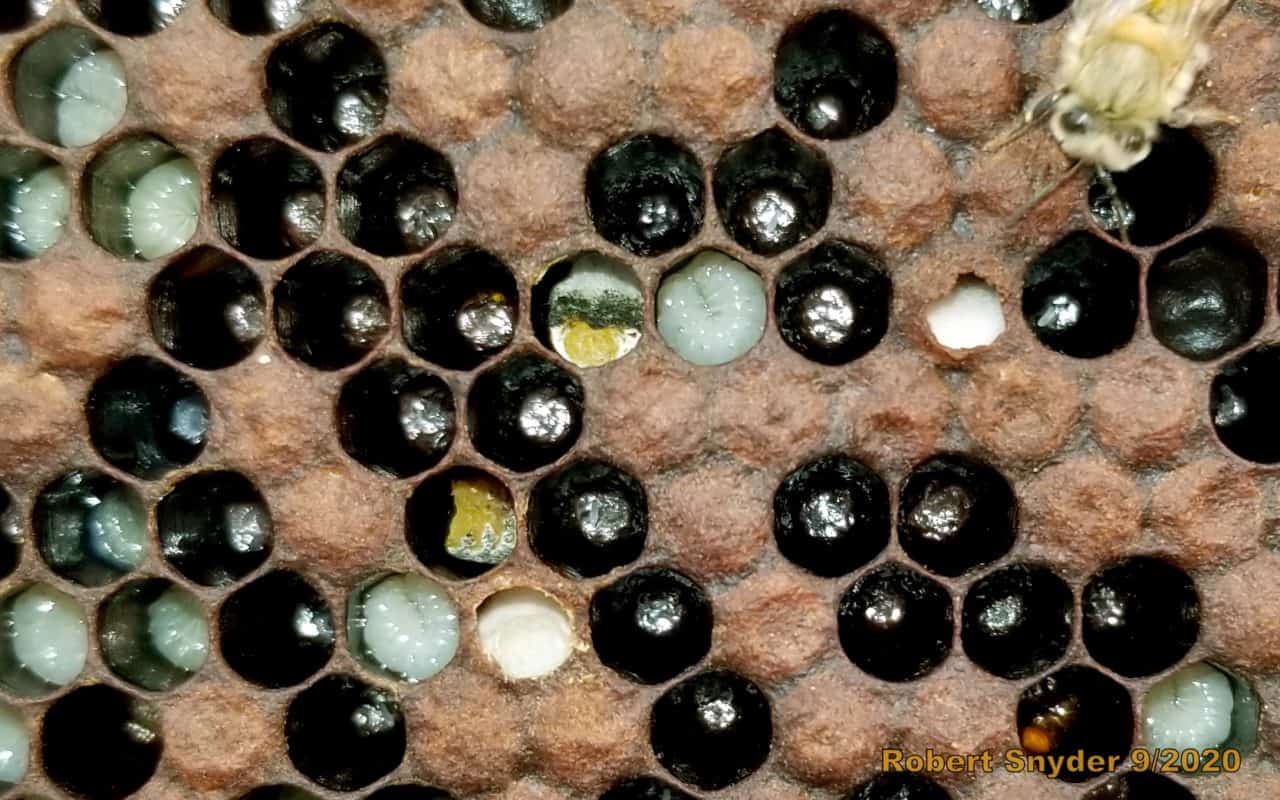
This image shows the results of a hygienic test.  You can compare the edges of the open cells to the open cells in the bald brood image.  This image also shows how the hygienic bees will start to chew down and remove pupae and larvae.

This image shows the results of a hygienic test. You can compare the edges of the open cells to the open cells in the bald brood image. This image also shows how the hygienic bees will start to chew down and remove pupae and larvae.

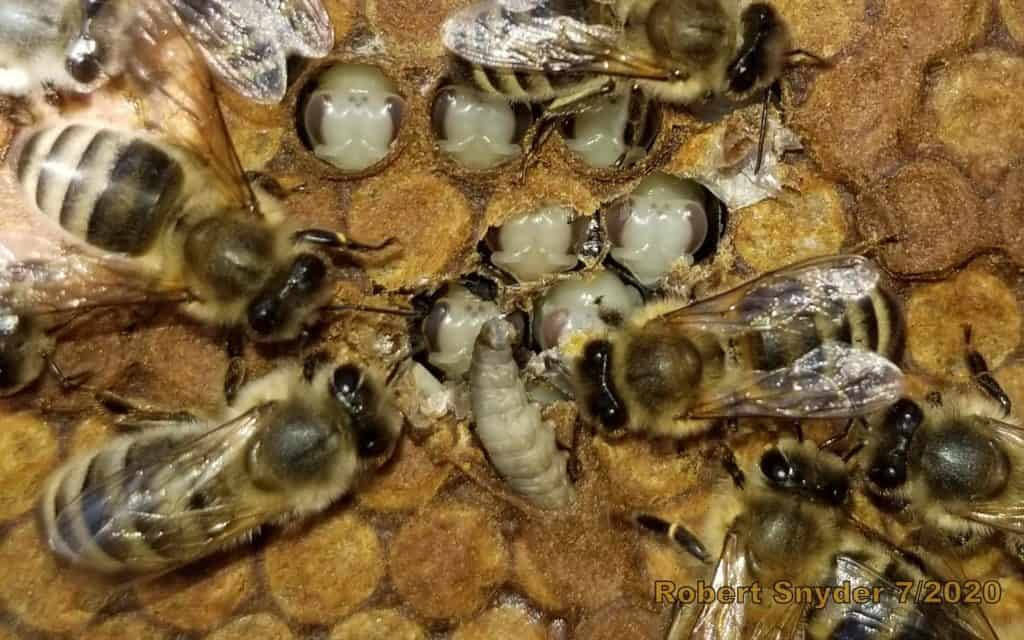
This is an image of hygienic behavior.  The bees are uncapping and chewing down larvae because they detected varroa mite, a lethal gene or some other brood disease.  Note there is no real pattern to the uncapping.  Also note the pepperbox brood pattern.

This is an image of hygienic behavior. The bees are uncapping and chewing down larvae because they detected varroa mite, lethal gene or some other brood disease. Note there is no real pattern to the uncapping. Also note the pepperbox brood pattern.

One may confuse the linear uncapping for early stages of chalkbrood so I have included this image to compare to bald brood.

One may confuse the linear uncapping for early stages of chalkbrood so I have included this image to compare to bald brood.

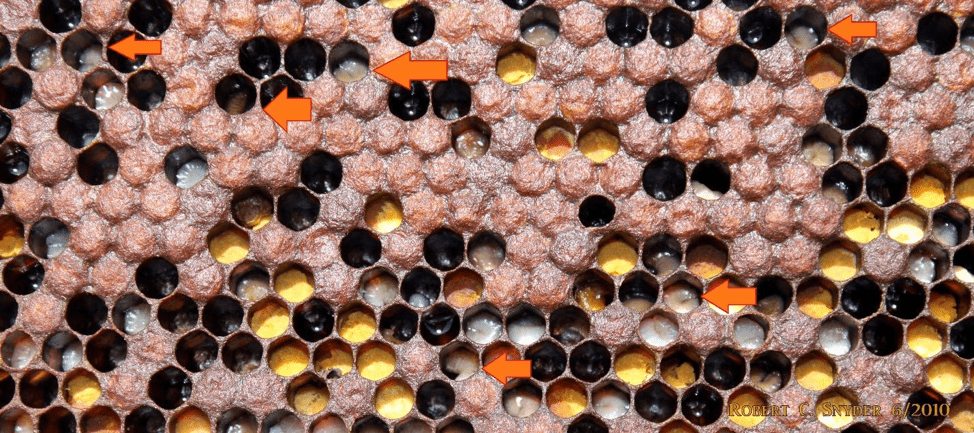
In this image you can see hygienic behavior displayed in circled uncapped brood.  I also circled some other problems related to varroa mite.  You will see a few bees circled with Deformed Wing Virus (DWV.)

In this image you can see hygienic behavior displayed in circled uncapped brood. I also circled some other problems related to varroa mite. You will see a few bees circled with Deformed Wing Virus (DWV.)

Unknown Brood Damage

Posted 4/17/2013

This blog was changed from the original post. The title has changed from Pesticide brood Kill to Unknown Brood Damage. This change was in response to the comments I have received both on this blog and by emails, I want to clarify a few of my comments. First, I regret the original title of the blog as correctly noted; I had no concrete evidence that it was a pesticide brood kill. No pesticide analysis was done on the pollen or bees because, as I mentioned in the comments section, this beekeeper knew what was being sprayed, when it was being sprayed and the bees consistently degraded in this area, year after year. I have provided clear examples in the photos below of other suspected diseases and I think they clearly show that this was probably not a brood disease, nor “BPMS or as it has more recently been termed Idiopathic Brood Disease Syndrome (IDBS).”

I have seen this type of brood damage only once in my career and it was a documented case of pesticide brood damage in Hawaii. We do strive to be transparent and for these blogs to generate discussion so we are going to keep this post up and I hope you find the added photos and the explanations on those photos helpful.

Sunflower Field in California.

Sunflower Field in California.

It’s not every day that you get to see chemical damage on a frame of brood in a honey bee colony. When you look at chemical damage in a hive it may look similar to other brood diseases but the symptoms just don’t add up to anything and you can clearly tell something is wrong with the brood. In this case a beekeeper contacted us and asked us to go out and look at colonies stationed in sunflowers for two weeks or more. There were also other crops around like vine seed and cotton. It was noted that the cotton in the area was sprayed and was still being sprayed with the insecticide “Belay”; however,the beekeeper did not notice the bees working the cotton. Belay is a third generation neonicotinoid used as a broad spectrum insecticide containing the active ingredient Clothianidin. It is used to treat for leafhoppers, beetles, plant bugs, aphids and Brown Marmorated Stink Bug (BMSM.) We then went out to inspect the colonies. They appeared to be good shape collecting pollen and nectar from the sunflowers and surrounding flowers. In one colony we found some chemical damage. I have included the images below from the chemical damage on the brood frames. I think chemicals caused these brood symptoms because it is not a like a typical disease or virus from my experience. I have included images of other diseases this might be confused for first to compare.

There are two arrows, the top arrow points to a bee with K-Wing, and the bottom arrow points to a worker removing a dead larvae from a cell.

There are two arrows, the top arrow points to a bee with K-Wing, and the bottom arrow points to a worker removing a dead larvae from a cell.

There are some broken down larvae and some scale in the cells.  Note there are some healthy larvae but the pattern is very spotty.

There are some broken down larvae and some scale in the cells. Note there are some healthy larvae but the pattern is very spotty.

In this image there are more chewed down larvae and some scale.

In this image there are more chewed down larvae and some scale.

Slightly to the right in the center there is a cell that I first though was AFB, but with further assesment AFB was ruled out.

Slightly to the right in the center there is a cell that I first thought was AFB, but with further assesment AFB was ruled out.

AFB brown larvae

“Coffee” brown larvae. Here is a look at AFB to compare.

In this image you can see some dead larvae and lots of scale.

In this image you can see some dead larvae and lots of scale.

This is a close up of the cell that looked like AFB, AFB is a coffee brown unlike this larvae.  Also examine the other larvae that have turned to a scale.

This is a close up of the cell that looked like AFB, AFB is a coffee brown unlike this larvae. Also examine the other larvae that have turned to a scale.

Posted 4/17/2013

Here are the reasons I think this is not a typical disease and a chemical issue. I will start with American Foulbrood. There are no perforations in sealed brood, larvae did not rope, no odor, no concave sealed cells, no proboscis from a pupa at the top of the cells. Also, the scale is wrong, scales from AFB adhere strongly to the lower sides of the cell. Now for EFB, symptoms not similar, scale does not match EFB scale which is easy to remove. With BPMS there is a population reduction, these hives were in good shape. Also the varroa levels were low. For the remaining 3 photos I put up, there were no symptoms of those problems. I think these photos help compare the difference, if someone has some other ideas please comment.

BPMS or  bee parasitic mite syndrome is different than EFB and can easily be confused. I think it is possible for both of these problems to occur at the same time.

BPMS or bee parasitic mite syndrome.

This photo is cropped from the image above.  It shows BPMS or bee parasitic mite syndrome, I will describe each lettered arrow. A.  Varroa mite on larvae, B.  This pupa was uncapped and a mite was detected so the bees started to cannibalize the head and will eventually remove the pupa, C.  There are 2 varroa mites on a larva, D.  This is similar to B.  The bees have chewed down a larvae or pupa because they detected a mite, E.  Note the absence of eggs and larvae; the colony is unable to rear healthy brood, F.  A varroa mite on a larva in a cell, G.  Here you see another mite on a larvae in the cell

This photo is cropped from the image above. It shows BPMS or bee parasitic mite syndrome, I will describe each lettered arrow. A. Varroa mite on larvae, B. This pupa was uncapped and a mite was detected so the bees started to cannibalize the head and will eventually remove the pupa, C. There are 2 varroa mites on a larva, D. This is similar to B. The bees have chewed down a larvae or pupa because they detected a mite, E. Note the absence of eggs and larvae; the colony is unable to rear healthy brood, F. A varroa mite on a larva in a cell, G. Here you see another mite on a larvae in the cell

 Bee parasitic mite syndrome (BPMS)  Here you see a chewed down larvae, you will see this often with BPMS.  This is a sign of mite sin hygienic colonies.  This image was also from the original above.

Bee parasitic mite syndrome (BPMS) Here you see a chewed down larvae, you will see this often with BPMS. This is a sign of mite sin hygienic colonies. This image was also from the original above.

European Foulbrood (EFB)

European Foulbrood (EFB)

European Foulbrood (EFB)

European Foulbrood (EFB)

European Foulbrood (EFB)

American Foulbrood (AFB)

American Foulbrood (AFB)

American Foulbrood (AFB)

American Foulbrood (AFB)

American Foulbrood (AFB) Deadout.

American Foulbrood (AFB) Deadout.

Sacrbood Virus (SBV)

Sacbrood Virus (SBV) with a varroa mite that crawled out of another cell.

Sacbrood Virus (SBV)

Sacbrood Virus (SBV)

Chalkbrood

Chalkbrood

Chalkbrood

Chalkbrood

Bald Brood

Bald Brood

Closer view of the sunflowers.

Closer view of the sunflowers.

European Foulbrood (EFB) Part 2.

European Foulbrood larvae turning into scale, also note the two cells with contaminated brood food.

European Foulbrood larvae turning into scale, also note the two cells with contaminated brood food.

The most problematic pest beekeepers encounter in the United States today is the varroa mite. The varroa mite (Varroa destructor) is an ectoparasite associated with spreading disease, pathogens and reducing the lifespan of male and female honey bees. The mites accomplish this by creating wounds in honey bees with piercing/sucking mouthparts, then feeding on the hemolymph within. Research suggests that these mites transfer single-stranded RNA virus between bees, along with infections of bacteria, including Melissococcus pluton (EFB). This type of bacterial infection of larvae or pupa is considered a secondary infection, since the mite initiated the process and the bacteria followed.

PMS or parasitic mite syndrome is different than EFB and can easily be confused. I think it is possible for both of these problems to occur at the same time.  At the bottom of this article I talk about colonies secondarily infected with EFB.  This could also just be symptoms of EFB and PMS together.

PMS or parasitic mite syndrome is different than EFB and can easily be confused. I think it is possible for both of these problems to occur at the same time. At the bottom of this article I talk about colonies secondarily infected with EFB. This could also just be symptoms of EFB and PMS together.

EFB is normally transmitted when the bacterium becomes mixed with the bee bread, nectar or diluted honey, and then fed to young larvae. The bacteria then replicate in the larvae mid-gut, killing the larvae within 4-5 days from when the egg hatches. With “normal” EFB, beekeepers generally see open brood infected with the bacteria, though you may see some dead larvae under perforated sealed brood. This is because when a larva is fed the bacteria, they can either live or die, depending on the bacteria concentration, and also the size of the food mass in the mid-gut. I believe that these bacteria can also gradually starve out a larva, causing death in the pupa stage. There are many images below of different stages of EFB and two compound microscope pictures from I. B. Smith, Jr. at the USDA in Beltsville, MD.

Melissococcus plutonius from comb Photo Credit:USDA I. B. Smith, Jr

Melissococcus plutonius from comb Photo Credit:USDA I. B. Smith, Jr

Melissococcus plutonius from comb  Photo Credit:  I. B. Smith, Jr.,USDA

Melissococcus plutonius from comb Photo Credit: I. B. Smith, Jr.,USDA

Here is the Brood Pattern from a colony with EFB.  A brood pattern like this is a very good indicator that EFB was present within the past few weeks.  Hygienic bees will remove sick larvae very fast making it hard to diagnose EFB or detect what is wrong with the hive.

Here is the Brood Pattern from a colony with EFB. A brood pattern like this is a very good indicator that EFB was present within the past few weeks. Hygienic bees will remove sick larvae very fast making it hard to diagnose EFB or detect what is wrong with the hive.

Brood frame with EFB and poor pattern.

Brood frame with EFB and poor pattern.

Healthy and EFB contaminated royal jelly.

Healthy and EFB contaminated royal jelly.

EFB Contaminated royal jelly.  Also there is an EFB scale in the cell above.

EFB Contaminated royal jelly.

European Foulbrood contaminated brood food.

European Foulbrood contaminated brood food.

Here you can see the larvae with EFB contaminated brood food in the cells.

Here you can see the larvae with EFB contaminated brood food in the cells.

Close up of bacteria contaminated brood food.

Close up of bacteria contaminated brood food.

EFB contaminated royal jelly in larvae to the right of the queen cell.

EFB contaminated royal jelly in larvae to the right of the queen cell.

Egg laid in a cell with EFB Scale at the bottom.  This would indicate the queen could transfer the bacteria.

Egg laid in a cell with EFB Scale at the bottom. This would indicate the queen could tranfer the bacteria.

Early stages of EFB in a few cells.

Early stages of EFB in a few cells.

Early Stages of EFB.

Early Stages of EFB.

Here you see early stages of EFB on the left and older stages on the right side.  Some are close to becoming a scale in the cell.

Here you see early stages of EFB on the left and older stages on the right side. Some are close to becoming a scale in the cell.

In this image you can see early to later stages of EFB, there is also some scale present.  Note the new larvae look healthy and the brood food is not brown or yellow.  This colony was treated with terramycin once.

In this image you can see early to later stages of EFB, there is also some scale present. Note the new larvae look healthy and the brood food is not brown or yellow. This colony was treated with terramycin once.

Different stages of EFB.

Different stages of EFB.

EFB varies depending on secondary bacteria that move in once the larvae is comprimized.

EFB varies depending on secondary bacteria that move in once the larvae is comprimized.

Here are larvae with the early stages of EFB, you can see one larvae starting to contort in the cell, commonly referred to as the “stomach ache position.”

Here are larvae with the early stages of EFB, you can see one larvae starting to contort in the cell, commonly referred to as the “stomach ache position.”

Here is some scale starting to form and also another larvae in the "stomach ache position."

Here is some scale starting to form and also another larvae in the “stomach ache position.”

This images shows most of the stages of EFB, however it does not show all the different types of secondary bacteria that can change its appearance and odor.  Note that EFB does not always have an odor.

This images shows most of the stages of EFB, however it does not show all the different types of secondary bacteria that can change its appearance and odor. Note that EFB does not always have an odor.

Various stages of EFB with seconary bacteria.

Various stages of EFB with seconary bacteria.

Another look at EFB, this symptom is most likely releated to one of the secondary bacteria that moves in.

Another look at EFB, this symptom is most likely releated to one of the secondary bacteria that moves in.

Here is brood in a colony with EFB, this is most likely result of a secondary bacteria.

Here is brood in a colony with EFB, this is most likely result of a secondary bacteria.

Another shot of what looks like a secondary bacteria infecting the larvae.

Another shot of what looks like a secondary bacteria infecting the larvae.

European Foulbrood Infected brood.

European Foulbrood Infected brood.

Larave in the "stomach ache position," it also looks like this larvae has been infected by a secondary bacteria.

Larave in the “stomach ache position,” it also looks like this larvae has been infected by a secondary bacteria.

Here are different stages of EFB, there is most likely a secondary bacteria involved here.

Here are different stages of EFB, there is most likely a secondary bacteria involved here.

EFB with secondary bacteria present.

EFB with secondary bacteria present.

EFB larvae infected with secondary bacteria.

EFB larvae infected with secondary bacteria.

EFB with secondary bacteria.

EFB with secondary bacteria.

EFB with secondary bacteria.

EFB with secondary bacteria.

Late stage of EFB with secondary bacteria.

Late stage of EFB with secondary bacteria.

European foulbrood in late stages, lots of scale in the bottom of the cells.,

European foulbrood in late stages, lots of scale in the bottom of the cells.,

European foulbrood in late stages, you can see the bees have cleaned up a lot of the infected larvae.

European foulbrood in late stages, you can see the bees have cleaned up a lot of the infected larvae.

Various stages of EFB and secondary bacteria.

Various stages of EFB.

Larvae with sunken trachea visible.

Larvae with sunken trachea visible.

Now I will discuss what I think is happening with a secondary infection due to mites. Mites can transfer EFB in a few ways, the first being when they enter the royal jelly before the cell is sealed. If the mite had the bacteria on its body, it could transfer bacteria to the brood food in the cell. The second method of EFB transfer is if the mite contained the bacteria inside the body, it could spread EFB through feeding. In this case, the mite would have to feed on the larvae once it’s free from the royal jelly. This would mean the larvae, now between 7½ and 8 ½ days old, has been infected with the bacteria. Normally larvae are infected as soon as they start consuming contaminated brood food. This infection with the bacteria at this late a stage in the life cycle may be detrimental to its lifespan and health because the limited food mass left in the bee. These symptoms are likely what are happening when you see signs of EFB in the open brood, and a lot of perforations in the sealed brood with different staged larvae/pupa. While the symptoms could look like mite damage, you clearly can see EFB infected larvae under perforated sealed brood (refer to images below). I have included images of what I believe is a colony secondarily infected with EFB by varroa mite. I also think these symptoms may be a delayed response to EFB or secondary bacteria. I have also included some EFB images above for reference. For more information on EFB see EFB Blog.

In this image you see the later signs of EFB where larvae are contorted then you also see lots of perforations in the sealed brood.  The holes in the sealed brood are probably from workers uncapping mite infested cells.

In this image you see the later signs of EFB where larvae are contorted then you also see lots of perforations in the sealed brood. The holes in the sealed brood are probably from workers uncapping mite infested cells.

In this image you can see I circled a number of perforated cells.  Some of these appear to have mite damage (uncapping) but the pupa could have also been secondarily infected by the EFB bacteria which killed them.  The melted pupa in the perforated cells either has EFB/Secondary bacteria or they have just been cannibalized down by hygienic bees.

In this image you can see I circled a number of perforated cells. Some of these appear to have mite damage (uncapping) but the pupa could have also been secondarily infected by the EFB bacteria which killed them. The melted pupa in the perforated cells either has EFB/Secondary bacteria or they have just been cannibalized down by hygienic bees.

In this image there is a lot going on.  You see many sick larvae and also sick larvae under perforated sealed brood.  There is also a larva in a cell with contaminated brood food.  I would think mites have transferred EFB to the pupa under the capped cell or there was a delayed response to the bacteria causing it to die later.

In this image there is a lot going on. You see many sick larvae and also sick larvae under perforated sealed brood. There is also a larva in a cell with contaminated brood food. I would think mites have transferred EFB to the pupa under the capped cell or there was a delayed response to the bacteria causing it to die later.

EFB with secondary bacteria and perforations in sealed brood.

EFB with secondary bacteria and perforations in sealed brood.

If you see this contagious brood disease in your colonies, the recommended treatment is three dustings of terramycin, 5 to 7 days apart. If you want to be sure you have EFB you can use a cotton swab and a ziplock bag and send samples to the USDA to be tested. If the symptoms return, repeat the steps above to clear up the bacteria. Tylosin is another broad spectrum antibiotic used to treat gram positive organisms, EFB is a gram positive bacteria but I have heard rumors from beekeepers that this antibiotic does treat EFB.

How to make a Sugar Roll jar

Varroa mite on bees thorax.

Varroa mite on bees thorax.

A sugar roll test is a simple way to monitor your varroa mite loads without killing a lot of bees. It is easy and fast and only a few items are needed. To make a sugar roll jar you will need a few supplies. You can get these supplies at a home improvement store and the grocery store.

• Wide mouth quart canning jar with a two piece lid. You can use other sized jars as long as there is a two piece lid.
• Screening-#8 mesh (8 squares per square inch) is preferred but you can use other screening as long as it allows the mite to fall through but keeps the bees contained inside the jar.
• Tin snips-used to cut out screen for replacing lid, refer to image below.
• Plastic white tub 11 quarts or more
• ½ cup measuring cup
• Confectioners’ sugar or powdered sugar

Sugar Roll Jar with lid and screen.

Sugar Roll Jar with lid and screen.

The first step to making a sugar roll jar is to remove the lid and remove the circular insert. Trace this insert on the screening using a pencil or black marker. Next you can take the tin snips and cut out the circular screen. Once the screen circle is cut out, place it under the threaded part of the lid to see if it fits. If it does not fit, trim with the snips until it does. Make sure there is no space for the bees to escape. Now your sugar roll jar is finished and ready for use.

Lids and cut screen for sugar roll jars.

Lids and cut screen for sugar roll jars.

There are many ways to perform a sugar roll. I prefer to first go into the colony and select a frame with sealed and unsealed brood. Then double check the frame to insure that the queen is not on it. If she is, gently move her to another brood frame in the colony or pick a different frame. Take the frame and tap it into the white plastic tub to remove the bees. I then shake the bees into the corner of the tub and take a full scoop of bees using the ½ cup measuring cup. Dump the bees into the sugar roll jar and screw the lid with screen on.

Tapping a frame into a white plastic tub for a sugar roll.

Tapping a frame into a white plastic tub for a sugar roll.

Shaking bees in a sugar roll jar.

Shaking bees in a sugar roll jar.

Next I will put powdered sugar over the screen and use my hive tool to push it through the screen into the jar. The time of year is the deciding factor of how much powdered sugar to put in the jar. If there is a nectar flow during the time of testing you will need to add more sugar. More sugar is needed to cover bees when there is a nectar flow because when you tap the frame in the plastic tub lots of nectar will cover the bees making it harder to remove mites. When you look into the jar, the bees should be completely covered in sugar. Once the bees are covered, take the ½ cup and place it over the screen. This will keep the sugar and mites inside the jar when you are shaking it. I usually shake the jar for about a minute. Shake the powdered sugar and mites onto the surface of the bottom of the plastic tub. If you want you can add more sugar and repeat if you feel you haven’t removed all of the mites. From what I have learned if you see 7 or more mites in a sugar roll, you should do something to reduce the mite numbers. Note: If there is a heavy nectar flow, it is not the best time to inspect a hive or perform a sugar roll. Inspecting a hive causes stress in the colony so it’s best to not disturb them for maximum honey production.

A case of sugar roll jars I made this spring.

A case of sugar roll jars I made this spring.

Spring Sampling in Northern California 2013

 2010 Almond Bloom in California.

2010 Almond Bloom in California.

Sampling large numbers of beekeepers takes considerable behind-the-scenes planning and work and this aspect of the project usually goes unseen and is underappreciated. I want to shed some light on what we all do to prepare for a hectic and fast-paced sampling season. Our spring sampling kits arrived from the east coast in several boxes. Team member Karen Roccasecca in Pennsylvania put the kits together consisting of a labeled alcohol bottle and virus sample bottle in individual bags. The individual bags contain both bottles and were grouped in 12 then placed into larger bags and eventually boxed. She then shipped them to our team at the Butte County Cooperative Extension in Oroville, CA.

Boxes from Pennsylvania with kits on the left and Kits finished for California on the right..

Once these kits arrive, we get them ready so that we can just grab a complete boxed kit and go. So from here, we unboxed all of the bagged sample bottle kits and organized them in the hallway from the lowest sample ID number to the highest sample ID number. These are numbers used as unique identifiers for each individual sample. The sample number is then correlated with a tag placed onto the hives starting with the number 1000 and is unique to each beekeeper. We then separated the bags into groups of 50 for each Beekeeper involved in the program. Next, we took the sample bottles and placed them into individual boxes and we placed a National Honey Bee Survey kit into each box (for more information visit Liz’s blog on “National Survey for Honey Bee Pests and Diseases in California”). The next things added to the boxes were sample tags, data sheets, treatment data sheets, and packing slips for virus/alcohol sample shipping. Before we placed the tags into the boxes, we had to gather all the unused tags from the previous sampling period. I have included an image to show examples of the tags.

Sample kit ready for tags, datasheets, management surveys and shipping labels  to be added.

Sample kit ready for tags, datasheets, management surveys and shipping labels to be added.

Tags for sampling colonies.

Tags for sampling colonies.

Kits ready for Sampling in California

Kits ready for Sampling in California

Bin with some supplies in it.

Bin with some supplies in it.

Also at the same time, we begin preparing our Rubbermaid bins with all the tools and items needed in the field to collect samples. An important part of this sampling period besides collecting alcohol samples and virus samples is the Hygienic test we conduct. The Hygienic test is used to measure hygienic behavior, a mechanism of disease resistance that demonstrates sensitivity to odors of brood diseases. Hygienic testing involves using liquid nitrogen to freeze-kill 160 worker pupae and then returning in 24 hours to assess the colonies ability to uncap and remove dead brood from cells. I have included some images from hygienic testing and for more information visit Mike’s blog on “Testing for Hygienic Behavior”.

Virus samples collected on Dry Ice to prevent the RNA from breaking down.

Virus samples collected on Dry Ice to prevent the RNA from breaking down.

Waiting for the frozen PVC to thaw before placing the frame back into the brood nest of a Hygienic test.

Waiting for the frozen PVC to thaw before placing the frame back into the brood nest of a Hygienic test.

A colony 24 hours after hygienic test.

A colony 24 hours after hygienic test.

A colony 24 hours after hygienic test, this colonly did very well.

A colony 24 hours after hygienic test, this colonly did very well.

We are about halfway through our breeder pool sampling for this year. Inclement weather has slowed down this year’s progress for both researchers and beekeepers. Things should start to pick up for us in the next few weeks.

Preparing frames for foundation

Frames with damaged foundation.Frames with damaged foundation.

Frames with damaged foundation.Frames with damaged foundation.

In the next few months beekeepers all over the country will start to inspect hives if they haven’t already. Some pests can be destructive over the fall and winter months. There are two common pests that cause damage during this time, mice and wax moths. Both pests cost beekeepers valuable time in fixing the problem and also money to replace the foundation if the frame is salvageable. Below is a video of me using my modified hive tool to clean foundation from top and bottom bars on frames. For more information on my modified hive tool, visit my blog “here”.
. I have included some images to show what type of damage wax moths cause. For more information on wax moth and photographs of both adult and larvae, you can visit my blog “here”. .

Frames with wax moth damage.

Frames with wax moth damage.

Frames after damaged foundation was removed.

Frames after damaged foundation was removed.

Nectar, Pollen and Pollen Substitute: Keys to a healthy colonly

Worker bee with yellow pollen in its corbicula(pollen basket) on a hive entrance.

In this blog I will talk about nectar, pollen and my theories on how honey bees utilize pollen/substitute patties and dry pollen substitute. So why do honey bees collect pollen? It would be hard to ask this question without asking why they collect nectar. Honey bees collect nectar from the nectaries of plants, which are glands that produce nectar. A honey bee uses her proboscis (mouthparts) to lap up nectar from flowers. There are some flowers in which the bee’s proboscis is not long enough to extract nectar, one example is the honey suckle flower. With this flower, bumblebees will chew a hole in the base of the flower to extract nectar, honey bees will secondarily visit the bumblebee’s hole to extract what nectar is left. With other deep flowers, the honeybee’s proboscis is not long enough to reach the nectar and more adapted insects such as Lepidoptera can take advantage of the nectar source or vertebrates, such as hummingbirds, can take a drink.

Worker bee cleaning, you can see the proboscis in this picture.

So what is nectar? Nectar is comprised of approximately 20% sucrose, 79% water and 1% other substances (vitamins, minerals, pigments, etc). Sucrose is also a very important product of photosynthesis in plants and is vital as an active messenger that relays information on the energy status of individual tissues. Honey bees use the enzyme invertase to catalyze the breakdown (hydrolysis) of the disaccharide sucrose in the honey stomach. It is broken down into two main monosaccharide’s glucose (dextrose) and fructose (levulose). These two monosaccharaides are more easily digested by honey bees. There are also some other sugars involved but these two are the most notable. They then distribute this “transformed” nectar around the edges of the brood nest to evaporate moisture from it. They will increase the rate of evaporation by fanning the nectar until the moisture content is 18.6% or less. If the moisture content is below 17%, it should not crystallize but this also depends on the amount of glucose in the nectar. Once the moisture content is low enough, the bees will cap the honey for storage. Honey is the bee’s main source of carbohydrates.

Transforming nectar to honey, this frame shows nectar and capped honey. This is a frame from a honey super.

Now that we know what nectar is comprised of we can start to look at pollen, its nutritional value and how it’s collected. So when talking about pollen you think, “where does it come from?” Pollen comes from the male reproductive structure called the stamen. The stamen consists of a filament and an anther. The pollen is on the anther. The movement of this pollen to the stigma (female reproductive structure) is pollination but that is another topic in its own. So how do bees collect pollen? It all starts when a worker bee flies near the flower. The movement of indirect flight muscles (visit my blog on Insect flight for more information) causes a buildup of static throughout the bee. Conveniently the bee’s entire body is covered with tiny hairs including the compound eyes so when the bee lands on a flower there is a static-cling effect where the pollen jumps onto the hairs on the bee. From here, the bees use their front legs to groom the pollen onto flat depressions surrounded by curved spines on the tibia of the rear leg. This depression is called the corbicula or pollen basket. It takes approximately 8-16 minutes for a bee to fill its pollen baskets. Once the pollen basket is filled the bee will return to the hive. Drones (male bees) lack this pollen basket and do not collect pollen.

This shot shows a worker bee that has generated static cling from flying and landed near dry pollen substitute, you can see the pollen substitute on the small hairs on the bee.

A worker going into the entrance of a hive in CA in the fall with loaded pollen baskets. There is still a lot of pollen still stuck to the hair on the bees also.

Heres some trapped pollen from one of my hives in PA. It is a sundance bottom trap.

What do bee’s use pollen for? Pollen is a bee’s main source of protein and is necessary for queen vitality and brood production. Pollen consists of proteins (chains of amino acids), lipids (fats), minerals, and vitamins. Before bees use pollen, they add nectar to the packed pollen and it goes through lactic acid fermentation. This process changes the properties of the pollen and allows the pollen to be stored in cells for a longer period of time without deteriorating like natural pollen in a cell would. At this point, it is now called bee bread. An interesting fact about pollen vs. bee bread is that regular pollen lacks vitamin K but once it has gone through lactic acid fermentation vitamin K is present. Why is this important? Vitamin K is important because it aids in protein biosynthesis (manipulating amino acids into new proteins). This may be important for royal jelly quality?

A variety of color in pollen coming in. This shot was from spring in PA.

Here is a shot of bee bread from the fall in one of my hives from PA.

Back to pollen vs. bee bread: I have always thought lactic acid fermentation occurred once the pollen was placed in the cell. However, recent studies show that there were traces of lactic acid bacteria in the honey stomach indicating that bee bread is possibly fermented in the honey stomach. To me this made a lot of sense because I always wondered, “Where does a pollen patty/pollen substitute go, what do the bees do with it?” But if they are fermenting it into bee bread (in the honey stomach) and utilizing it right away, it would be hard to detect except where you see increased amounts of royal jelly in the 2-3 day old larvae cells). I will go off topic a little here to talk about royal jelly to explain my previous statement. Royal Jelly is a protein-rich secretion that the worker bees feed to 2-3 day old larvae of drones and workers. The royal jelly also contains lipids, vitamins hormones, minerals, enzymes and other life-sustaining compounds. The queen is fed this substance her entire life and it is the single reason how she became a queen in the first place. Royal jelly contains royalactin which is the single protein that triggers the development of ovaries in a diploid egg which then eventually transforms into a queen. This is why pollen/pollen supplement feeding is important for queen vitality. The queen needs a constant supply of protein rich (many different amino acids) royal jelly. Where is royal jelly made and what bees make it? The worker bee’s hypopharyngeal gland in the head is the production plant of royal jelly. Though this gland is not developed soon as they emerge, the gland develops to full size within 6-12 days depending if sufficient pollen is in supply for the worker bee to utilize. Therefore if there is not a sufficient amount of pollen, the whole colony is malnourished as well as the most vital part, the queen. This is also the reason many times why a colony will not re-queen itself properly; there is an insufficient amount of protein rich pollen to support the cells. Now back to the dry pollen supplement.

Larvae with lots of royal jelly in the cells, notice the pollen at the top also. It is always good to look for pollen/bee bread in the brood nest.

On this frame you see very little unsealed brood and there are no young larvae being reared. You can attribute this to very little pollen or nectar source available. These colonly would benifit from a pollen substitute at this time.

But then what happens when bees are fed dry pollen substitute? If you have been in a yard when they are being fed dry pollen substitute you can open a hive and see the pollen packed into the cells. I would guess the bees are saving this pollen until they have enough nectar/water to convert the powder into “bee bread.” Once converted it is used in the same way as a “wet” pollen patty. I have included some images of bees with pollen and dry pollen substitute on their corbicula.

Dry Pollen substitute packed into the pollen basket of a worker bee.

Dry pollen substitute feeder for commercial use, they hold approximatly 30-34 lbs of dry substitute.

Heres a worker bee face deep in a small pile of dry pollen substitute, you can also see the start of a pellet on the hind let in the pollen basket.

Whats wrong with my hive?

Healthy Cordovan queen.

To determine if something is wrong with your hive, you must first know what a healthy, productive hive looks like. Knowing what a healthy colony looks like takes time, patience, and many hours in the hive to get a feel of what is going on in the colony throughout the year. Sometime the colony does not look so great and the size of the colony starts to dwindle. You can do two things here, panic or take a look at what is actually going on. Look at the brood, look at the bees(size, wings, uniformity, behavior), look at the sealed brood, look at the food stores, look at the entrance, feel the weight of the hive, notice any odors that may be emitting form the hive, and listen to the hive. These simple things can help identify problems in the hive.

The way I learned these diseases was from my professor Dr. Robert Berthold. He had frozen frames of the different diseases that he has showed us. There were also detailed lectures on the different diseases. This was enough to get me started, but didn’t really mean much to me until I started inspecting hives for the PA Department of Agriculture where I was able to utilize the information and knowledge learned to help beekeepers diagnose problems with their honey bee colonies. Over the years I have learned a great deal more and seen many problems that I couldn’t identify but that I could at least rule out some causes. During this learning curve, I have taken hundreds of photographs of diseased bees, healthy bees and bee behavior. Recently my co-worker Mike Andree and I have started to document some of these disease and behaviors on video. In the near future we will be posting some of these videos with our experiences to help beekeepers identify problems in their hives.

Below are images I have taken comparing healthy frames of brood to ones that are not so healthy. It will cover a majority of brood diseases and other problems found in the hive. This is not a comprehensive guide; it is a collection of images displaying different diseases and symptoms within the hive to help diagnose these problems. Hopefully this will help beekeepers identify issues in their colonies.

This is a frame of sealed brood from a healthy hive. Notice the solid brood pattern. Also note that there is no pollen stored on this frame. It’s important to look for pollen on other frames to assure they have adequate pollen stores.

This frame of brood has Chalkbrood, There are arrows pointing to the cells infected with the fungi Ascophera apis. Notice the shotgun brood pattern. There is not much chalkbrood on the frame so the bees are removing the chalkbrood mummies out through the entrance.

Drone pupae infected with the Ascophera apis fungus. Shortly the whole pupae will be a chalky sponge-like mummy.

Chalkbrood mummies just outside the hive entrance. If the brood pattern has a very spotty/shotgun appearance, look at the entrance to see if these mummies are present. I almost always look at the entrance before going into the hive.

Here is another sealed brood frame from a healthy colony. Notice how this colony has much more pollen stored around the brood nest.

This brood frame has European Foulbrood. Melissococcus plutonius is the causative bacteria that out competes the larvae for food killing it before it is sealed. For more images see my blog on EFB.

This brood Frame has AFB or American Foulbrood. You can tell by the perforations in the cappings. Also note the shotgun brood pattern. You can also see sunken or concave cappings on the frame where they are normally convex shaped.

Paenibacillus larvae is the American Foulbrood bacteria that infects larvae and kills them once they are sealed. Here you see sunken cappings, perforations in cappings and infectious larvae.

Here is another frame of sealed brood from a healthy colony. The lighter color cappings represents newer wax that has not been contaminated with debris yet.

The final stage of Sacbrood Virus(Morator aetatulas) is when it changes from grey/white to black. The bees will often remove them before they get to this stage. See my blog on SBV for more information and images.

PMS or parasitic mite syndrome. Notice there are no larvae or eggs in the open cells, the bees are unable to rear healthy brood.

This image shows PMS with mites feeding on brood, you can also see an arrow pointing to a chewed down pupa and varroa mites in the cells.

This images shows bees with Deformed wing virus (DWV), Parasitic mite syndrome (PMS) and also you see pupa being uncapped by bees that detected mites in the cell.

Here you see DWV and more pupa being chewed down. These are signs of heavy varroa mite infestation.

The bee on the far left has disjointed wings also called K-wing. A number of things can cause this incuding nosema, tracheal mites and possibly viruses.

Yellow Jackets

With winter approaching and food sources dwindling honey bee colonies are starting to be harassed by pests. Yellow Jackets are one of the most common pests, they feed on bees, larva, brood, honey bee bread and pretty much anything they can take advantage of in the hive. During this time of year when robbing becomes a problem, the yellow jackets will follow. During the chaos there is an open opportunity for yellow jackets to move in and take advantage of the situation. In Butte County, CA it was a very dry year so the yellow jackets will be a more serious problem with the lack of forage and resources for them.

Yellow Jacket bites into honey bee abdomen

Beekeepers have a few choices to try to combat these ferocious predators. You can set up bait traps that are available commercially or you can construct you own. You can easily construct a trap using 2L bottles and filling the bottom with sugar syrup (an inch or so). You can use other things as bait such as meat, fish, chicken or rotting fruit if you are trapping a lot of honey . Sugar syrup is the easiest to dispose of and the same trap can be used over repeatedly with rinsing. You can either keep the bottle whole or cut the top third of the bottle off and flip it so the small open part of the bottle is pointed down. It should look like a funnel; this allows wasps to get in but makes it hard for them to get out. This method works much better than just a plain bottle with syrup in it.

Another thing beekeepers do is place entrance reducers on their hives; this limits the space that guard bees have to protect. If it is still warm in your area, it may be best to use a screen reducer to ensure proper ventilation. You can check my previous blog on entrance reducers for images. Also duct tape any holes in the hive bodies or lids. You can also staple small screen over the holes.

For the more ambitious beekeepers I have some solutions to find the source of the problem. Yellow Jacket nests are usually found close to the source of food. The nests are in the ground in old rodent burrows. The following procedure steps through how to coat wasps with powdered sugar to track them. To find the nest, get a plastic cup, preferably clear (glass works too). Now find something to place over the top of the cup that is thick enough so that the wasp cannot sting through it (coasters work great). The next step is personal preference; I put confectioners’ sugar into the cup before catching the wasp. Some will put the confectioners’ sugar in afterwards but then you run the risk of the wasp or wasps escaping. You can now head out to the yard. It is best to do this in the morning before honey bees are in full forage and when it is cooler. Once you catch a wasp in your cup you want to give it one shake to cover the wasp with the sugar. You can now let the wasp go and watch where it flies. It will hopefully fly back to its nest. The powder sugar helps you see the wasp when it flies away; it also helps distinguish it from flying honey bees. You may need to do this a few times with several wasps before you find the nest. This does not always work and if I don’t find them within 30 minutes or so I give up and just hope the traps take care of a majority of the wasps. I will sometimes do 20-30 wasps and walk around and look for white wasp activity near the ground.

Heres a quick diagram I drew of this simple Bait Trap.

If you do happen to find the nest there are a few tricks to kill them. You can take a pot of boiling water dump it down the nest entrance. It is best to do this at night to ensure most of the wasps are present in the nest and to avoid being stung. If you don’t have access to boiling water you can spray the entrance with a registered insecticide. Do not seal the entrance of the nest if you use the insecticide, this allows for other wasps that may have stayed out to come in contact with the insecticide. It is also best to use this at night. Avoid using a headlamp because the wasps will come for the light if they do come out of the nest. If they do come out, turn the light off and walk away, once the lights gone you will be ok. Another tip I recently heard was to place a bucket over the hole and let it there for several days. If on an uneven surface, use a folded towel to ensure the entrance is completely sealed. I have not tried this method but if anyone does, please comment with the outcome.

Phorid Fly (Light Trapping)

Prototype 2 (Phorid Fly Light Trap)

The past few months I have been trying to capture honey bees that are infected with Phorid Flies in the Chico, CA area. So what is a Phorid Fly? It is a fly commonly referred to as the humpback-fly because of its appearance. Previously the fly was known to parasitize bumble bees and paper wasps but has now transferred host and is able to reproduce using the honey bee (Apis mellifera). It has been termed the “Zombee” because once parasitized, the honey bee behaves irregularly, taking flight at night and dying away from the hive. More information on this name and the fly can be found at (https://www.zombeewatch.org/) and in this articles from PLoS ONE (http://www.plosone.org/article/info%3Adoi%2F10.1371%2Fjournal.pone.0029639). It has been found that setting light traps can lure the bees at night and I have been doing so for some time now.

Prototype #1 (Phorid Fly Light Trap)

I will share some of my experience so far in looking for the Phorid fly. Setting a light trap up near honey bee colonies will most certainly attract bees. In some cases you will collect a lot of bees, some dead and some alive. I like to hang my traps at dusk and then collect them the next day. I hang most of my traps from trees so it helps me if I place a sheet underneath of the light (white is best). If you don’t have a sheet, it is best to look for flat surfaces to hang or set your trap. I bring a rake with to clean the area of debris; this makes it easier to look for dead, crawling, disoriented or exhausted bees. It’s hard to tell if a bee is exhausted, sprayed with a pesticide or infected with the Phorid fly larvae so it is important to keep live crawling bees in separate containers from dead bees. I do the same for any drones that are collected whether dead or crawling. As in the tutorial (https://www.zombeewatch.org/tutorial) to prevent you from getting stung, pick up bees with tweezers or forceps. If using a sheet you can congregate the bees into the center and pick out the moving bees and place them into a separate container.

Dead and crawling bees under one of the light traps.

When collecting the bees it is important to record information. I record the date and time I set up the trap and the time I collect the bees from the trap or the ground. I also note what kind of light trap I used. I will put an individual label into or on the outside of each container describing its contents. I will also write down this information on a notepad to later transfer to an excel spreadsheet to store electronically. To store and rear any potential Phorid flies from the bees, I use cut off water bottles but any container will do. Avoid excess water in containers as this will cause mold to grow. A clear container is preferable to help see pupa on the sides of the container or emerging larva. I like to use paper towel squares to cover the opening and secure it on top with a rubber band (see image below). This prevents suffocating the fly larvae since decomposition will consume oxygen in a sealed container. This is important if collecting larger specimen samples.

Phorid Fly Rearing Containers

Now that you have the bees in the container you can store them in a dark room at room temperature. Avoid keeping them in sunlight since this may dry bees out prematurely and desiccate fly larvae. After a week or two, it is a good time to check the containers to see if any Phorid flies have emerged from the dead bees. You can often see pupal cases stuck to the sides of the containers. Once you see the pupal cases you have a few more weeks to wait for adult flies to eclose from the cases to positively identify if these flies are Phorid flies. It is important to save adult flies either pinned or in alcohol for positive identification and possible state or county records. If I find some Phorid flies, I will continue this blog with some more insight and photographs.